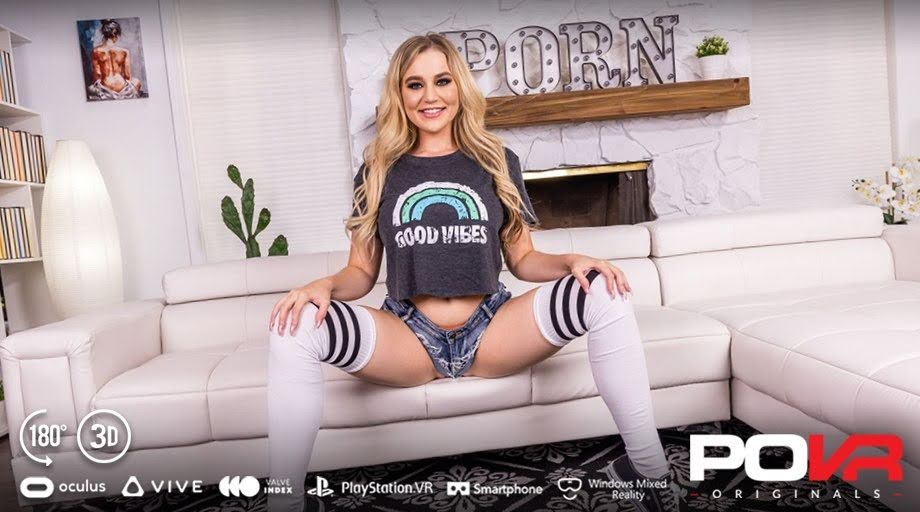
Porn stars in VR: the side of your favorites you can’t rate from a clip
Rating sites work because clips and photo sets compress a performer down to something you can put a number on. Looks, body, screen presence, a scale of one to ten, done. It’s a fair game and everyone knows the rules.
But there’s a question the format can’t answer: what is this person actually like when they’re three feet away, talking to you? That used to be a hypothetical. Now it’s a fairly literal description of watching porn stars in VR, and it’s where the usual rankings stop working.
What watching porn stars in VR is actually like
If you’ve never put on a headset for this, the mechanics are worth spelling out, because they explain everything else in this article.
VR adult scenes are shot POV. The camera sits where your head would be, at eye height, and the performer plays the entire scene directly to the lens. In the headset, that translates to a life-size person in front of you who looks you in the eye when they talk. There’s no frame and no editor cutting to a better angle. The current standard on the premium side is 8K stereoscopic video at 60 frames per second, which is sharp enough that “watching a video” stops being how your brain files the experience.
The first time is genuinely strange. I’ve watched people demo VR for years, and the reaction to a well-shot scene is never “nice video.” It’s usually silence, then some variation of “okay, that’s different.” Eye contact from a screen is nothing. Eye contact from someone who appears to be sitting on the bed you’re on is a different circuit entirely.
It’s a different skill, and not everyone has it
Flat scenes are made in the edit. A director shoots coverage, picks the best takes, cuts around anything flat or awkward. VR removes almost all of that safety net. Scenes run long, often 30 to 60 minutes, frequently in continuous takes, because cuts are jarring when the video is wrapped around your head. The performer carries all of it: forty-plus minutes of energy aimed at a camera rig they have to treat as a person, with no second angle to hide in.
Some big names are noticeably worse in VR than in their regular work. The charisma that reads on a flat screen turns out to live in the editing. And some mid-tier performers turn out to be exceptional at it, because the format rewards a specific talent: making a lens feel looked at. Casting for VR is its own problem, and not because of looks: acting to empty space convincingly is closer to stage work than to traditional shooting.
Which means the leaderboard changes. If someone built a rating system around VR performances specifically, the top twenty would overlap maybe half with the usual lists. That missing half is the story.
The OnlyFans parallel
None of this should surprise anyone who’s watched the creator economy for the past few years. OnlyFans proved that the real product is the feeling of access. Subscribers pay for the DM, the custom video, the sense that this specific person knows they exist. Polish matters less than presence.
VR is that same insight, pushed to its physical limit. It manufactures presence directly, the experience of being in the room with someone instead of reading a message from them. So it makes sense that the two worlds are converging. Studios increasingly recruit creators who already know how to work a front-facing camera and talk to one viewer, because that’s ninety percent of the VR skill set. The traditional path ran through an agency and a casting call. The new one runs through being genuinely good on a phone camera.
Where this actually lives
A practical note, because the ecosystem is less obvious than it should be. You won’t find any of this in a headset app store. Meta and the other platform holders ban adult apps outright, so the entire industry runs through the headset’s web browser and through video player apps that stream from the open web. In practice that’s simpler than it sounds: you put on the headset, open the browser, and play scenes directly from the site, the same way you’d use any streaming service. Browsing POVR this way is also the fastest way to see how many familiar names have built VR catalogs, since studio releases from most of the industry end up aggregated in one place, filterable by performer.
The one real requirement is the headset itself. A Quest 3S handles all of this fine, so the entry cost is lower than most people assume. Free teasers exist everywhere and are heavily compressed, which is worth knowing before you judge the format on one.
The rating that doesn’t exist yet
The qualities that make a performer great in VR are mostly invisible in a highlight clip: whether their eye contact lands or slides past you, whether they can hold a room for forty unedited minutes, whether the talking feels aimed at someone or at no one. None of that fits in a photo score.
Fans will build that vocabulary eventually, the same way they built one for everything else. In the meantime, there’s a strange window where the format’s best performers are undervalued and some famous ones are coasting on flat-screen reputations. If rating talent is the hobby, VR is currently the most interesting unscored category in it.